
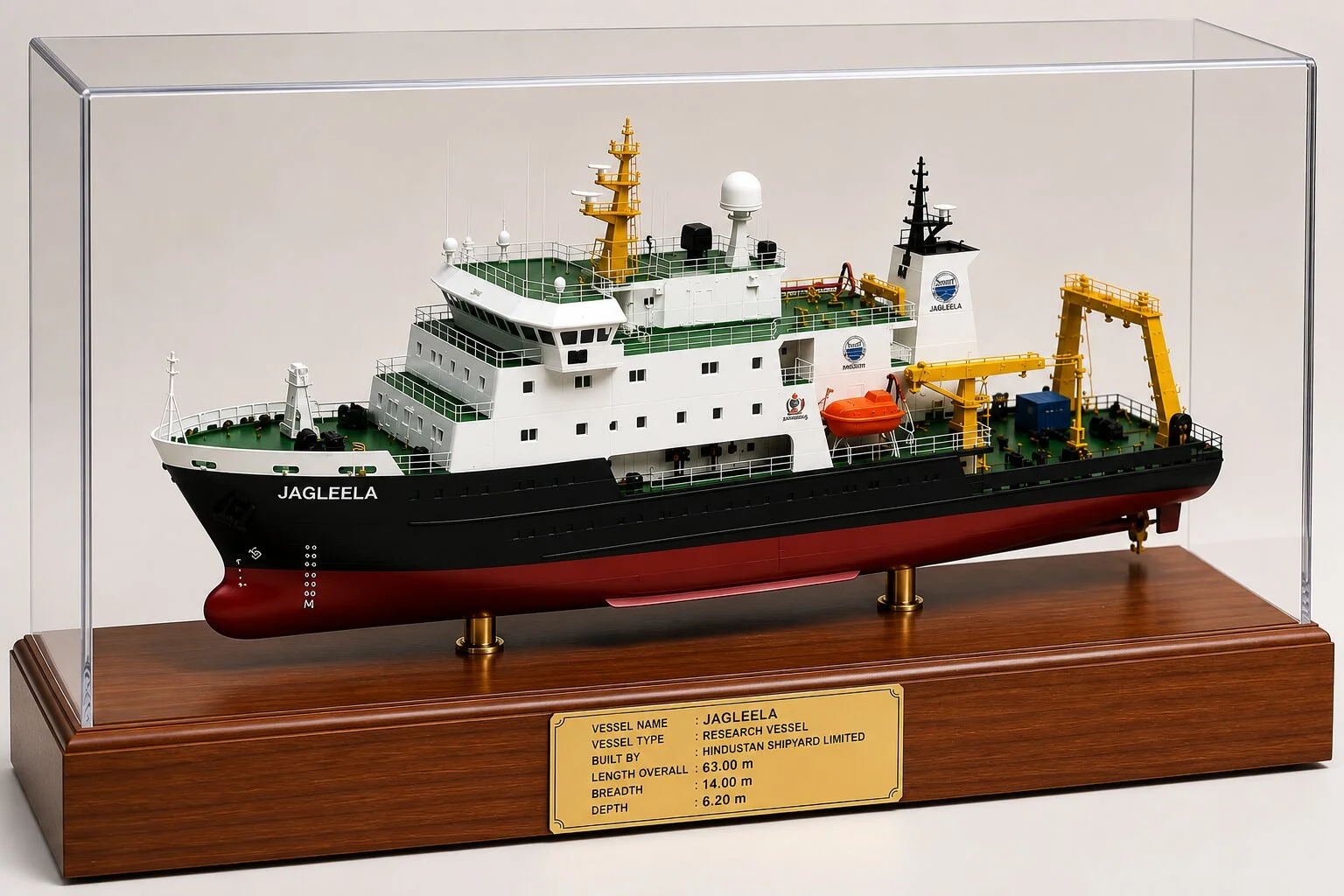

Picture a room full of engineers, contractors and client representatives trying to agree on how a new platform will be installed. There are drawings on the wall, a projector humming, and a stack of printed layouts nobody has time to read. Then someone rolls in a table with an offshore platform model on it, and the conversation changes within seconds. People point at the crane. Someone asks where the lifeboats go. Another person notices that the flare boom is closer to the living quarters than they’d assumed.
That’s the real value of these models. They don’t replace engineering software. They make everyone in the room look at the same object at the same time.
A quick tour of what’s on the model
An offshore installation has several distinct parts, and a good model shows each one clearly. Fixed platforms stand on a steel jacket, a lattice of tubular legs and braces that reaches down to the seabed and is held in place by piles. Above the water sits the topside, which carries the processing modules, the power generation, the utilities and the accommodation block.
Then come the smaller but important elements: the helideck, often perched on the edge of the living quarters; the flare boom that extends outwards to burn off excess gas; the pedestal cranes; the lifeboat stations; the drilling derrick if the platform has one; and the risers and conductors that pass through the jacket. Getting the relative positions right is what separates a convincing model from a decorative one.
Where models earn their keep
The first use is in tenders and client presentations. When several contractors bid for a fabrication or installation job, a model helps a client understand the proposed approach far more quickly than a bound report can. It also signals seriousness. A company that builds a physical model of its design is telling the client it has thought hard about the details.
The second is design review. Even in a modern workflow where everything is drawn in three dimensions, people notice things on a physical model that they missed on screen. A walkway that looks fine in a drawing may feel cramped when you see it at scale. A crane that seems well placed may block access to a laydown area.
The third is installation planning. Marine operations teams use models to talk through how a topside will be lifted, how a jacket will be upended and lowered, or where a heavy-lift vessel will position itself. Small moveable pieces on a model can help a team rehearse the sequence before real money is on the line.
Safety, training and communication
There’s also a human side. Offshore workers need to know their platform well, especially escape routes, muster points and lifeboat stations. A model gives new joiners a quick orientation before they ever step on a helicopter. It makes safety briefings less abstract and allows trainers to point out the route from the accommodation block to the nearest evacuation point.
For companies that deal with regulators, insurers or local communities, models can also make complex proposals easier to explain. Not everybody reads engineering drawings, but nearly everybody understands a model.
How these models are built
The starting point is always the drawings: structural layouts, general arrangement plans, equipment lists and elevations. The maker chooses a scale that suits the purpose. Something like 1:100 or 1:150 gives room for visible detail on a compact platform, while a larger complex may go smaller to keep the overall size sensible.
The jacket is usually the most laborious part. Every leg, brace and node has to line up, and hundreds of small tubes may be cut, fitted and joined. Topside modules are built as separate blocks, which makes it possible to show removable roof panels or open sections when someone wants to look inside. Details like handrails, stairways, grating and pipe racks are added gradually, using etched metal, printed parts or hand-formed wire depending on scale.
Finishing matters. Marine steel is rarely bright and glossy. A muted paint scheme with correct colour coding for the helideck, the lifeboats and the safety areas looks convincing and reads well under showroom lighting. Many models sit on a sea base, made from layered acrylic or textured resin, with a small plaque listing key dimensions or project data.
There’s a quieter benefit too. Once a model exists, it keeps working. It sits in the project office through fabrication, gets pulled out when a subcontractor asks a question, and stays in the reception area after the platform is installed as a reminder of what was delivered. Drawings get filed away and forgotten, while a model keeps being looked at.
Common mistakes buyers make
One is treating the model as an afterthought. Teams often ask for it a week before the client visit, and then wonder why it looks rushed. Structural models with lots of small members simply take time, and no amount of pressure makes hundreds of tiny braces assemble themselves any faster.
Another is failing to lock the design. Offshore projects evolve, and a model built on outdated drawings starts to mislead. If the layout is still changing, agree with the maker on which version is being used and how updates will be handled.
A third is ignoring practicalities. If the model has to go to a conference in another city or another country, packaging and transport need to be planned from day one. Long crane booms and flare stacks are fragile, and no one enjoys unpacking a broken flare boom in front of a client.
Thinking about your own project
If your team is preparing a bid, a review or a training programme, it’s worth seeing what a specialist can do with an offshore platform model before you commit to a scale or a budget. Ask to see finished pieces, discuss which parts must be removable, and be honest about who will use it. An engineer, a trainee and a client executive will all look at it differently.
Final thoughts
Offshore projects are expensive, complex and unforgiving of misunderstanding. A well-built offshore platform model can’t fix a weak design, but it can help everyone involved see the same thing clearly and catch small problems early. That alone makes it a useful working tool, and an easy way to bring a large structure down to human size. For teams that want their message understood quickly, a good physical model is often the simplest option on the table, quite literally.